From the Front
THE REBELS IN FULL RETREAT—OUR BRAVE BOYS DRIVE THEM FROM SHILOH—THE FEDERAL ARMY TRIUMPHANT—A DESPERATE ATTEMPT TO FLANK US DEFEATED—THE 102D U. S. COLORED TROOPS SUFFER HEAVILY—GENERAL GRANT SLIGHTLY WOUNDED—ON TO CORINTH!
The sun rose this morning upon a very different army from that which greeted yesterday’s rude awakening. The battalion drill, which yesterday furnished our camp with considerably more amusement than instruction, was conducted this morning with such marked improvement that even the most skeptical observer was compelled to admit that our boys had learned their lesson.
There was no throwing of officers’ hats today.
This is perhaps the surest indication that the army is recovering its discipline.
Early in the morning religious services were held near camp, and it was our privilege to hear a sermon in which the Rev. gentleman made reference to that celebrated rebel commander, Thomas “Stonewall” Jackson, whom he described as a “great Christian man.”
Great, indeed!
He may be a great Christian man, if a man may claim greatness while employing his Christian virtues in the business of killing Union boys.
We confess that we should prefer our Christianity with rather less stonewalling and considerably less slaughter.
Mr. Lincoln himself was present at the service, lending an impressive dignity to the occasion.
But the prayers were scarcely concluded before the armies were again engaged.
The rebel forces had established themselves in the vicinity of Shiloh Church, and our troops advanced upon their position with a determination which has characterized the Federal soldier throughout this campaign.
For a time the enemy attempted a most dangerous maneuver against our flank. Had they succeeded, the consequences might have been serious. But our boys were equal to the emergency. The movement was detected in time, the line was rapidly adjusted, and before the enemy could complete his design, our men had cut off the attempt and driven the rebels back.
From that moment the tide turned.
Forward went the Federal columns.
The ground over which our men advanced was marked by the terrible evidence of the previous day’s fighting. Body upon body of the fallen Confederate lay upon the field, and our soldiers passed through this melancholy harvest as they pressed the enemy steadily backward.
The retreat soon became a rout.
The rebel army, once so confident, fled toward Corinth, leaving behind its dead, its wounded, and whatever confidence it may once have possessed.
Michigan may well be proud today.
The men who were yesterday driven from their camps have returned to the field with their courage renewed and have helped drive the enemy from his own.
There were terrible losses on our side as well. An entire company of the 102d United States Colored Troops was swept away by cannon fire. They fell where they stood, and their sacrifice deserves to be remembered alongside that of every regiment which has paid in blood for the preservation of the Union.
Nor were the horrors confined to the soldiers.
As the rebels fled the field, one of their last volleys was fired toward those who had gathered nearby to witness the contest. Among those struck was a young girl.
There can be no excuse for such conduct. Let those who speak so loudly of the refinement and civilization of the Southern cause explain what military necessity required them to fire upon spectators and a helpless child.
The enemy is gone.
Corinth lies before us.
And now, boys—
HURRY ON TO CORINTH!
The enemy is running.
Let us see how far he can run before the boys in blue overtake him.
A Word Concerning Our Commander.
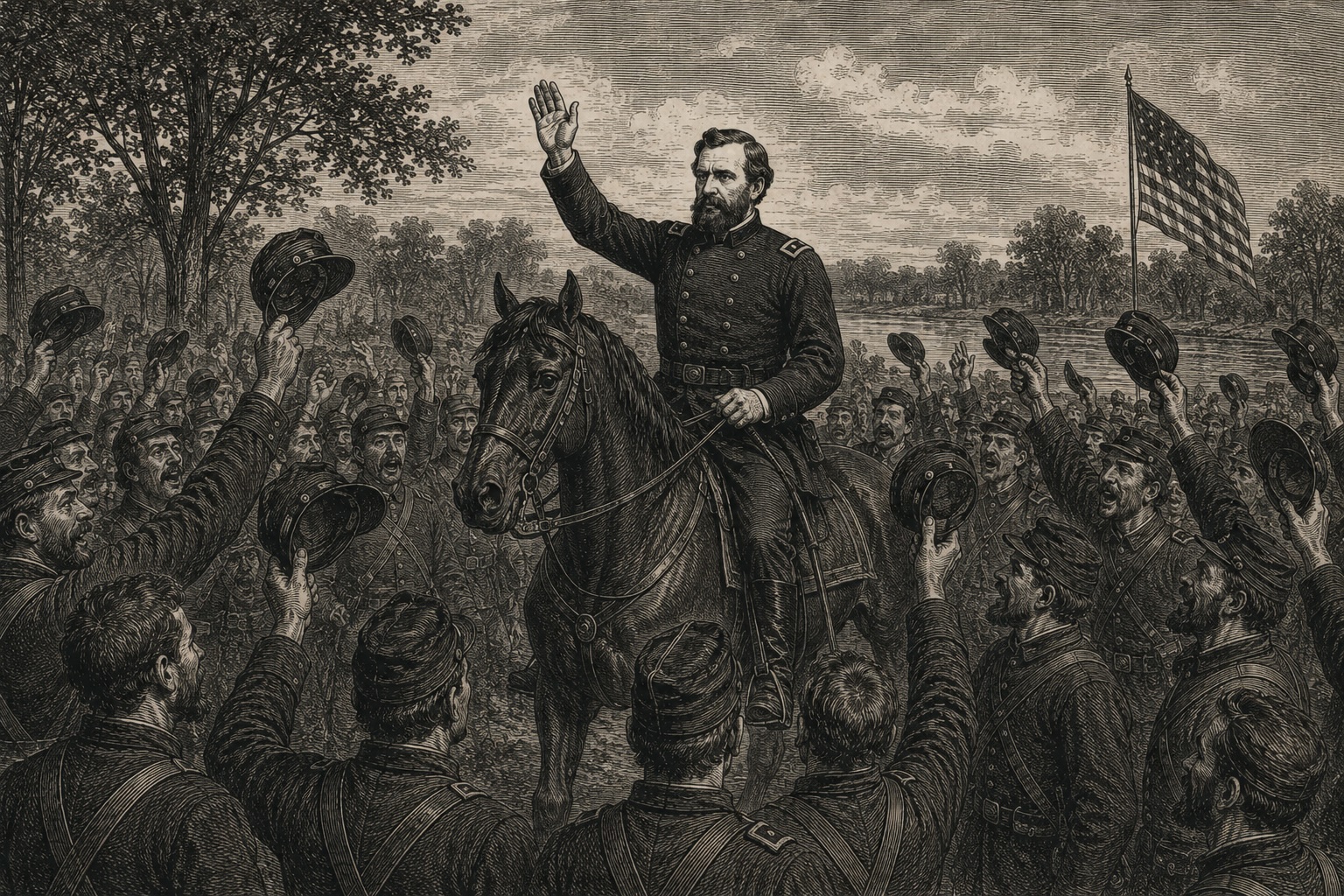
We are pleased to report that General Grant, though suffering an injury to his ankle, remains in good spirits. We sincerely wish the General a speedy recovery. An injured ankle is an inconvenience, certainly, but we trust it will not prevent him from directing the pursuit.
Indeed, we suspect the General has little inclination to sit quietly while the rebels are running toward Corinth.
There has been some idle talk concerning the General’s conduct during yesterday’s surprise, but we are now satisfied that certain remarks attributed to this correspondent were the result of an unfortunate interference with our dispatches.
The reader will understand that in the confusion of a campaign, communications may sometimes be altered, misplaced, or otherwise tampered with by persons whose motives are not entirely friendly to the Union.
We therefore beg the public to disregard any previous suggestions that General Grant was lacking in confidence, judgment, or military ability.
We have never entertained such doubts.
Certainly not.
The General has today demonstrated that he possesses exactly the qualities required to bring this campaign to a successful conclusion.
The 102d Colored Troops
An entire company was swept away by cannon fire before Shiloh Church. They fell where they stood, and their sacrifice deserves to be remembered alongside that of every regiment which has paid in blood for the preservation of the Union.
A celebration of the Colonel
It is alleged that after our splendid victory the battalion sang a tune in celebration of the Colonel’s birth. If such a rumor is true, this correspondent has no direct account of any such music that could be heard above the tuneless droning of the weary men. Yet we offer well wishes nonetheless to our brave Colonel. Huzzah!
Thoughts for the Night
Victory has a way of settling old scores of memory as well as of arms. Let us hope tomorrow needs no explaining.